Sometimes standards are wrong
Posted: 06/08/2025
While working on my projects, I have encountered some standards and practices that conflict with each other (i.e. one disobeys the other). Why is this important?
-Things that look like standards at first glance may be treated more like loose guidelines or
objectives in practice.
-Organizations may be unaware that something they operate or build is below standard.
-Organizations can misunderstand standards and laws and mistakenly disobey them by lack of understanding.
-You can misunderstand standards and laws and mistakenly think organizations are disobeying them by
your lack of understanding.
-Such standards can impact what you are allowed to or should design,
even if someone is not following them at that particular moment.
-Others' mistakes are harder to correct the more people make them.
Due to the above, it is important to triangulate (finding multiple sources that back up your claim) and/or find potential deviations from standards where possible. These conflicts occur more often than one might think. Below, I list two examples from my projects this year where standards have conflicted with practice or each other. Both are transit and transportation-related as my projects have mostly been in that area.
Case 1: Lane widths
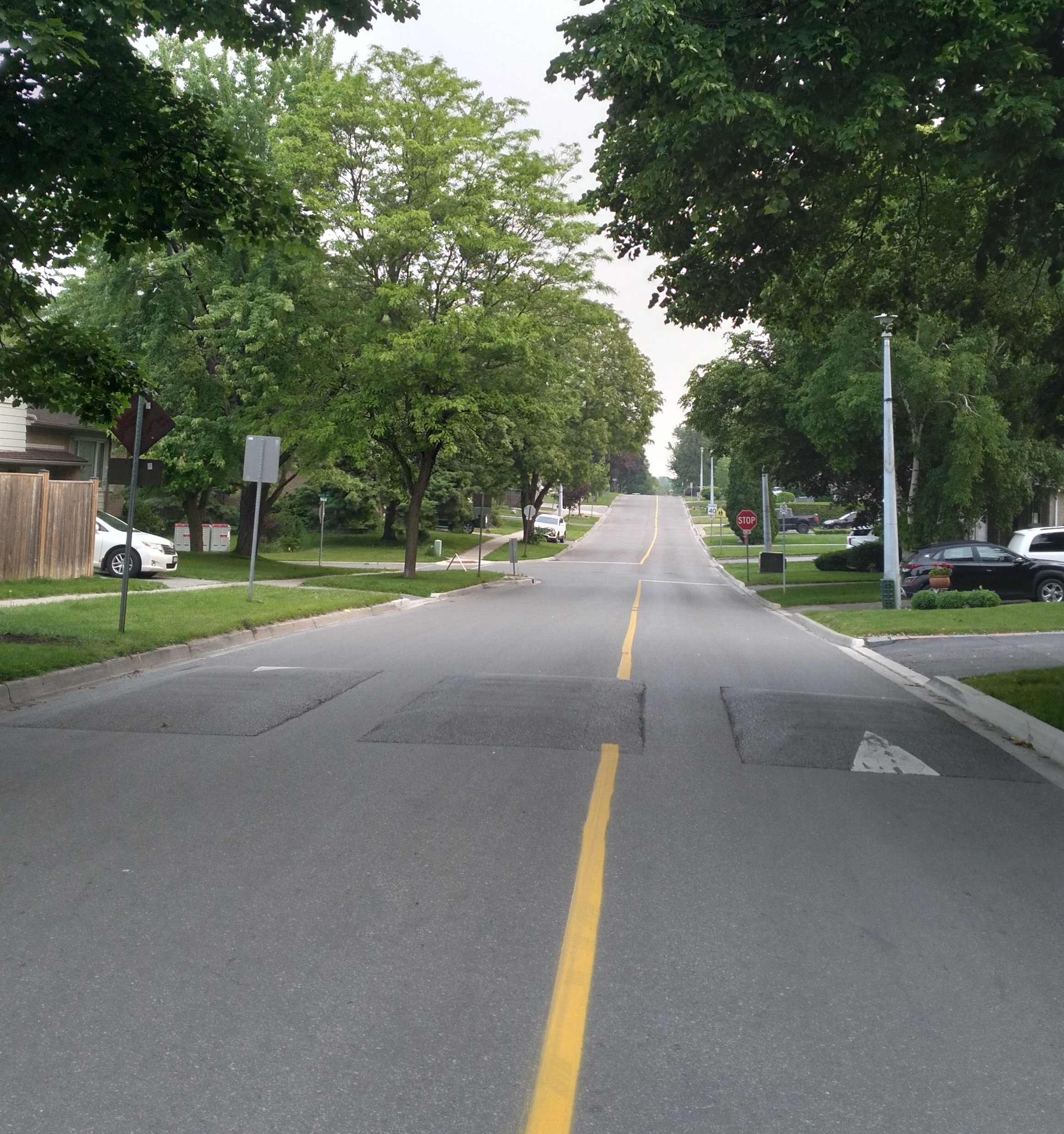
A similar street I found this morning
After showing my friend Lucas Gaspari a selection of route ideas for my West Aurora Network Study (WANS) last week, he told me that Seaton Drive (a road which one route idea would run on) had lane widths too narrow for bus operation. The street itself has two asymmetrically wide lanes, with one side allowing street parking. Yesterday morning, I went there and measured the lane widths. Indeed, the shorter side is only 3.0 to 3.2 metres wide, lower than the 3.3 metres YRT requires. However, YRT is planning to run a school special along Seaton Drive in September despite the narrow lanes. Some other Aurora streets including those used by some of my other route ideas have similar designs, this morning I observed it on Batson Drive west of Old Yonge and all of Walton Street north of Birch Court.
With a potential conflict emerging, I looked to see what other Greater Toronto agencies require. The City of Toronto strongly recommends a 3.3-metre lane width, but considers 3.0 metres the absolute minimum if 3.3 metres can not be acheived for queue jump lanes and at stops. With the above in mind, I will treat a 3.3-metre width as an important objective rather than a constraint with 3.0 metres being the constraint. I have not yet determined exactly how important a 3.3-metre lane width should be, but it appears the City of Toronto only allows 3.0-metre lanes when absolutely necessary.
Case 2: How crowded can a bus be?
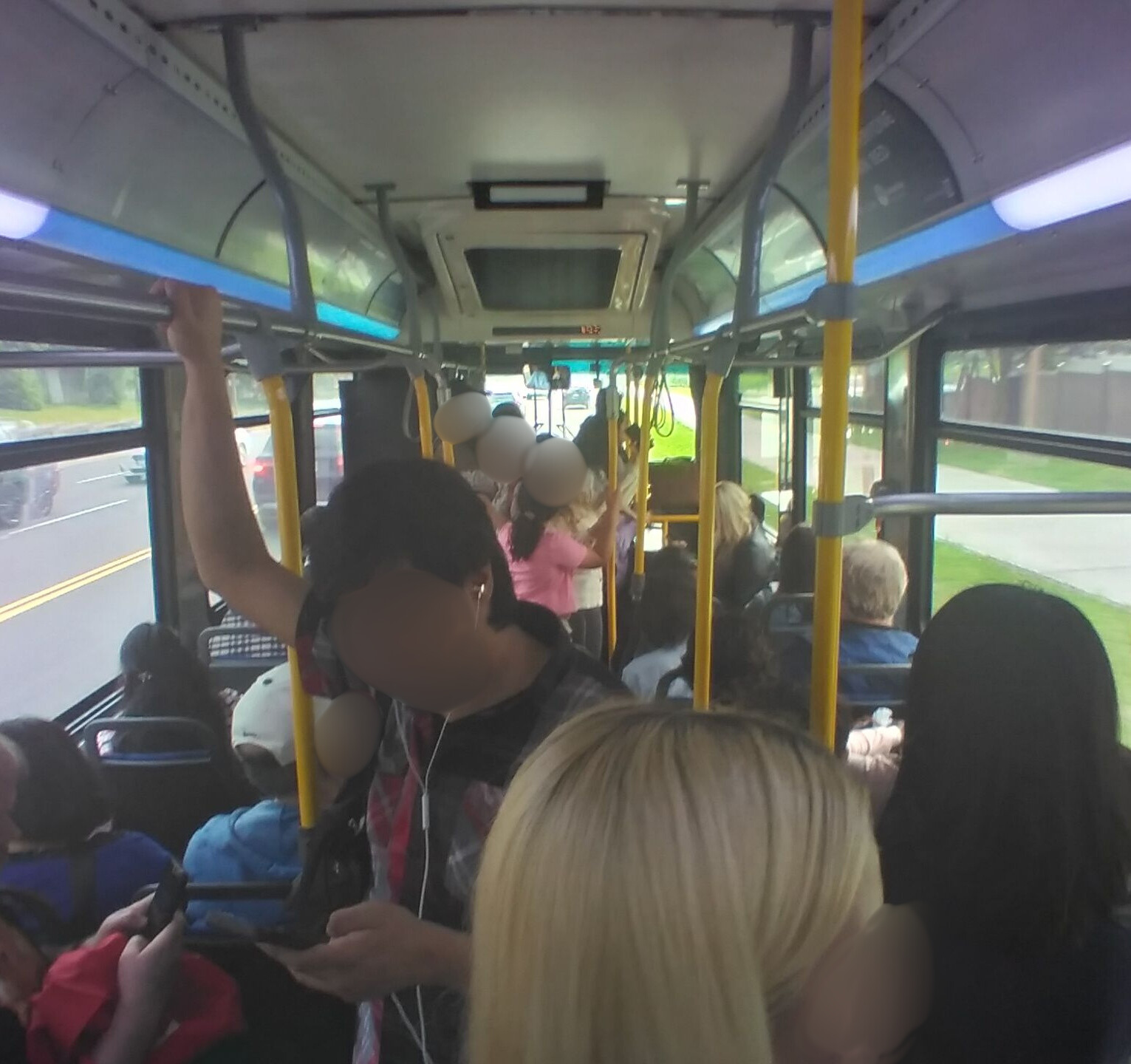
This bus had one too many people.
When I originally conceived this article, it was primarily focused on this case (I found case 1 while thinking about this). While looking at transit service standards of a few agencies for my 7 - Martin Grove project last winter, I came across a part in Brampton's standard about the Public Vehicles Act (PVA), an Ontario law which had a provision prohibiting any bus operating across municipal borders from having more standing passengers than a third of its total seats. This was news to me, as I initially thought it applied to controlled-access highways rather than across municipal borders.
The confusion was not limited to me, I had heard others also claim that such a regulation only applied to highways and in practice, I have only seen it applied to York Region Transit (YRT) route 360 - Vaughan Mills/Wonderland, with some buses running on arterial roads rather than highways when they were too full. However, this rule was never applied consistently. When I later complained to YRT about crowding I observed while collecting traffic data for my John Street project (not mentioning provincial legislation), they said that such a rule applies to all routes operating on 400-series highways.
In the early 2020s, the Ontario government deregulated the intercity bus industry and repealed the PVA, replacing some of its provisions with a new regulation under the Ontario Highway Traffic Act (OHTA) which includes the aforementioned provision. The new regulation exempts buses travelling within Waterloo Region and Niagara Region, as well as considering both sides of Steeles Avenue as part of the City of Toronto. 400-series highways were not mentioned in this law and all public roads are covered under the OHTA.
Some of the provisions in this new regulation lead me to believe that Brampton's interpretation is accurate. Both sides of Steeles Avenue being considered part of the City of Toronto is important for the TTC, which has many routes ending at Steeles and most of its bus fleet has fewer sets than other Greater Toronto transit agencies. As well, both Waterloo and Niagara have regional transit agencies which would benefit from this regulation not applying to them.
With this in mind, I continue to follow Brampton's interpretation of the old Act. However, I will contact others in the field (perhaps linking here) after this page is published.
What to make of this
It's rather unfortunate that conflicting official sources are a problem we have to deal with, but it's clear that people in the industry often make mistakes. To avoid potential misinformation from spreading, we need to ensure the information we have is accurate when we work on projects, when we write reports, and in communication with the public about whatever we or others are designing. If you are confident, perhaps reach out to whoever made the standard or whoever is disobeying it. I plan on exploring both cases more in the coming weeks to ensure I have a full understanding of them.